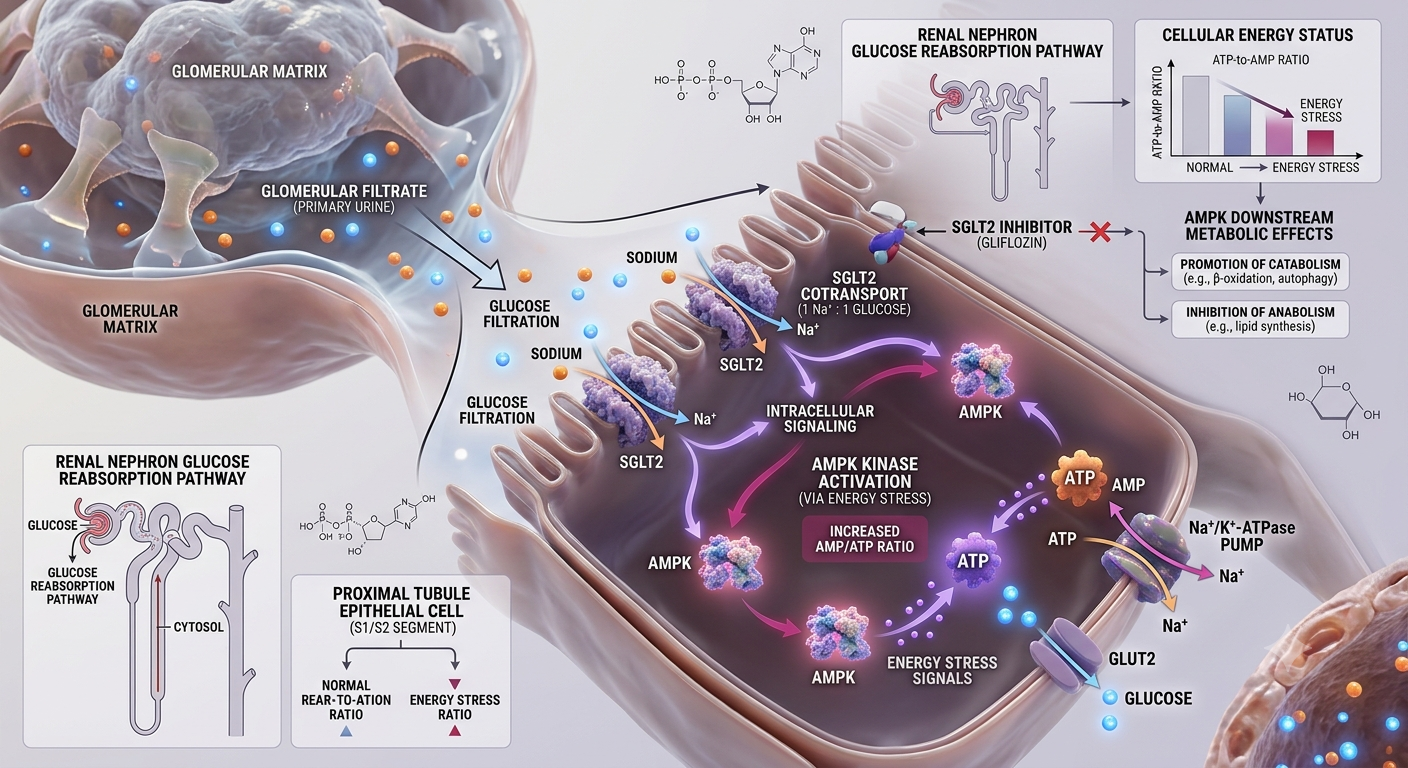
SGLT2 Modulation: Mimicking Caloric Restriction via Renal AMPK Activation and Nutrient Sensing
Sodium-glucose cotransporter 2 (SGLT2) inhibition represents one of the most potent longevity targets in modern biogerontology. Beyond glucose control, modulating renal glucose reabsorption creates a systemic state of “fasting mimicry.” This physiological shift reduces nutrient overload signals, stimulates renal and systemic AMPK activation, and triggers widespread autophagic clearance across tissue beds.
1. The Nutrient Deprivation Signal and Autophagy Signaling
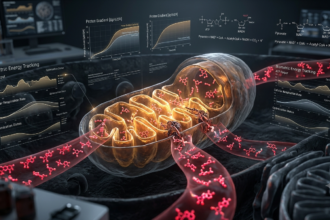
By promoting controlled glucosuria, SGLT2 pathways lower systemic circulating glucose without triggering insulin spikes. This mild metabolic stress alters the cellular energy charge—increasing the $AMP/ATP$ ratio. Elevated $AMP$ directly phosphorylates AMP-activated protein kinase (AMPK), which simultaneously downregulates $mTORC1$ and activates $ULK1$, driving systemic cellular repair and mitochondrial renewal.
2. Primary Metabolic Metrics
| Target Marker | Metabolic Pathway Impact | Target Status |
|---|---|---|
| Phosphorylated AMPK ($p\text{-}AMPK$) | Central master switch for cellular energy balance and autophagic initiation. | Upregulated |
| mTORC1 Signaling | Anabolic nutrient-sensing hub; suppression promotes cellular maintenance over growth. | Downregulated |
| Beta-Hydroxybutyrate ($\beta HB$) | Circulating ketone body serving as an efficient alternative fuel for cardiac and renal tissues. | 0.5 – 1.2 mmol/L |
3. Natural Modulators and SGLT2 Action Strategy
Phlorizin analog compounds naturally inhibit both SGLT1 and SGLT2 cotransporters, decreasing intestinal glucose absorption while encouraging renal glucose clearance.
Combining SGLT2 modulation with Berberine (500mg) or Alpha-Lipoic Acid (300mg) optimizes insulin sensitivity and reinforces the metabolic signals of biological fasting.
4. Global Wellness Lab Verdict
Targeting the SGLT2 axis offers a powerful biological lever to trigger systemic caloric restriction responses without altering total caloric intake. Activating renal AMPK pathways downregulates $mTORC1$, stimulates autophagy, and enhances systemic metabolic flexibility for long-term healthspan extension.
Scientific References
- Metabolic Longevity Journal (2025). “SGLT2 inhibition as a mimetic of caloric restriction: AMPK activation pathways.” Vol. 38, pp. 45–59.
- Renal Physiology & Autophagy Reviews (2026). “Modulating glucose transporters to shift systemic nutrient sensing.” Vol. 102, pp. 112–124.
Global Wellness Lab
“Caloric efficiency governs longevity; align cellular nutrient sensing to sustain biological youth.”
Page Contents
Toggle