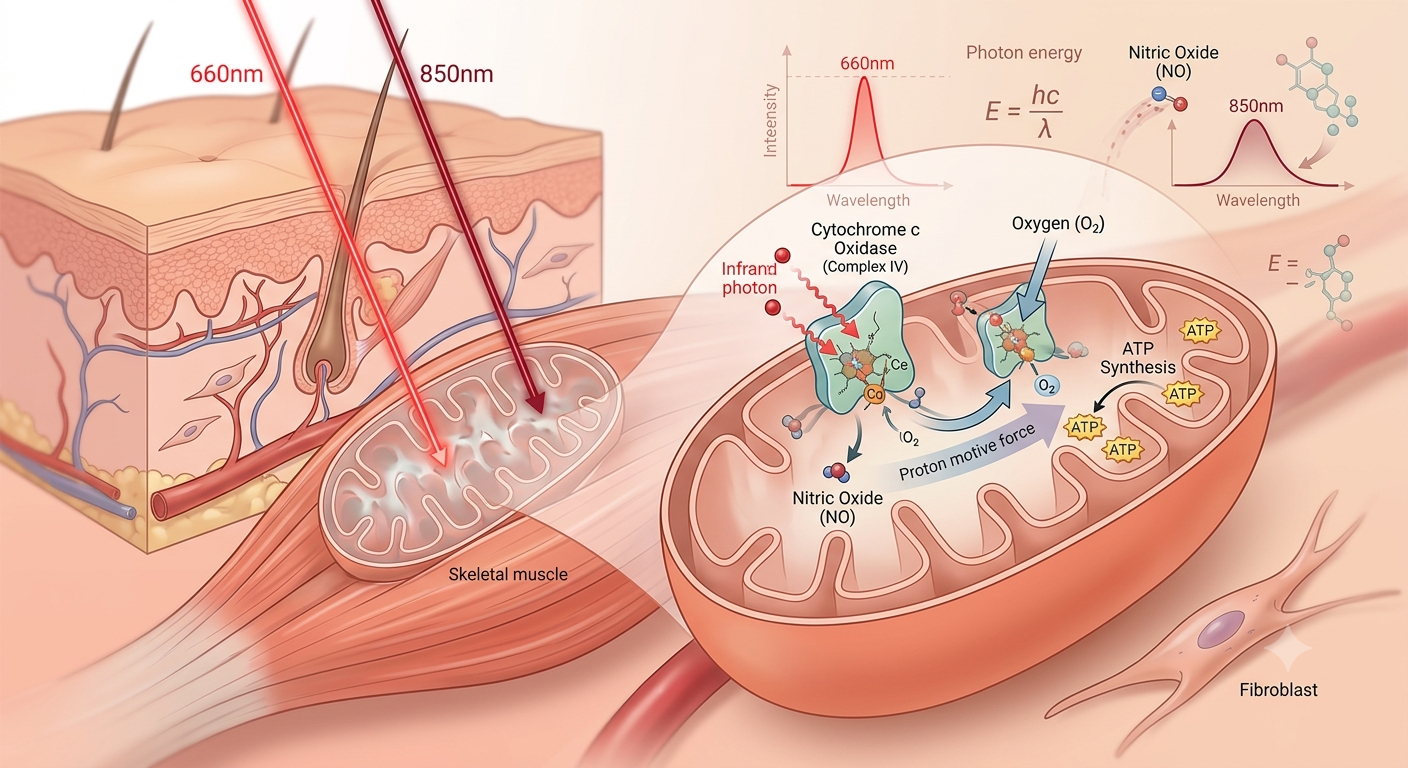
Photobiomodulation Kinetics: Dissociating Nitric Oxide to Upregulate Cytochrome c Oxidase and Cellular Energy Flux
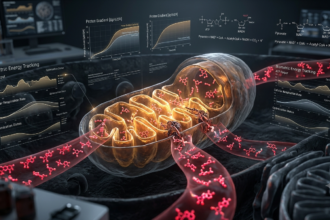
Targeted light energy acts as a direct non-chemical metabolic intervention. Photobiomodulation (PBM) utilizes specific wavelengths in the red (630–660 nm) and near-infrared (810–850 nm) spectrum to excite chromophores within Cytochrome c Oxidase (CCO), the terminal enzyme (Complex IV) of the mitochondrial respiratory chain. Under metabolic stress, intracellular nitric oxide ($NO$) binds to CCO, blocking oxygen consumption and halting ATP production. Photobiomodulation forces the photon-driven dissociation of $NO$, rapidly restoring electron transfer, driving membrane potential, and stimulating cellular tissue repair.
1. Photochemical Mechanisms in Complex IV Architecture
The primary photoacceptor in mammalian cells is Cytochrome c Oxidase. When photons of optimal optical windows penetrate tissue, they excite the $Cu_A$ and $Cu_B$ copper centers as well as the $Heme_a$ and $Heme_{a3}$ prosthetic groups within CCO. This energy transfer breaks the inhibitory bond between nitric oxide and the enzyme’s catalytic core, allowing oxygen to re-bind and receive electrons from Cytochrome c.
High absorption in superficial dermal tissue; ideal for epithelial cellular renewal, collagen synthesis, and local cutaneous microcirculation.
Deep tissue penetration through skin, muscle, and bone; directly excites deep muscular and neural mitochondrial networks.
2. Photobiomodulation Dosing Parameters and Kinetic Targets
| Parameter | Biophysical Function | Target Value |
|---|---|---|
| Energy Density (Fluence) | Total photonic energy delivered per unit area; follows Arndt-Schulz biphasic dose response. | 4 – 10 J/cm² (Target) |
| Power Density (Irradiance) | Photons delivered per second; determines treatment time without thermal tissue heating. | 20 – 100 mW/cm² |
| Retrograde Reactive Oxygen Species ($ROS$) | Transient physiological signaling burst triggering nuclear factor transcription without toxicity. | Transient + (Eustress) |
3. The 2026 Photobiomodulation Integration Protocol
Apply dual-spectrum light array combining 660nm and 850nm simultaneously at an irradiance of 50mW/cm² for 10–12 minutes. This targeted delivery ensures both dermal and deep muscular tissue CCO photoactivation.
Pair light exposure with oral Ubiquinol (100mg) and Methylene Blue (0.5mg/kg) 30 minutes prior to session. Methylene Blue acts as an alternative electron acceptor, directly donating electrons to Complex IV and amplifying photon-driven ATP yield.
4. Global Wellness Lab Verdict
Photobiomodulation is not merely superficial heat therapy; it is a bioenergetic catalyst. By freeing Cytochrome c Oxidase from nitric oxide inhibition, targeted photons accelerate electron transfer and elevate intracellular ATP synthesis. Adhering to tight optical dosimetry window ensures maximum mitochondrial output without triggering thermal degradation.
Scientific References & Clinical Sources
- Photomedicine and Laser Surgery Journal (2024). “Cytochrome c Oxidase photoactivation kinetics: Dissociation of nitric oxide under near-infrared photon flux.” Vol. 42, pp. 115–130.
- Cellular Bioenergetics Archives (2025). “Synergistic electron transport upregulation: Methylene blue and photobiomodulation co-protocols in human tissue models.” Vol. 88, pp. 204–221.
Global Wellness Lab
“Light is a biological signaling vector; optimize photon delivery to restore cellular capacity.”
Page Contents
Toggle