Microglial Priming: Molecular Mechanisms, TSPO Biomarker Tracking, and Resolution Protocols for Central Neuroinflammation
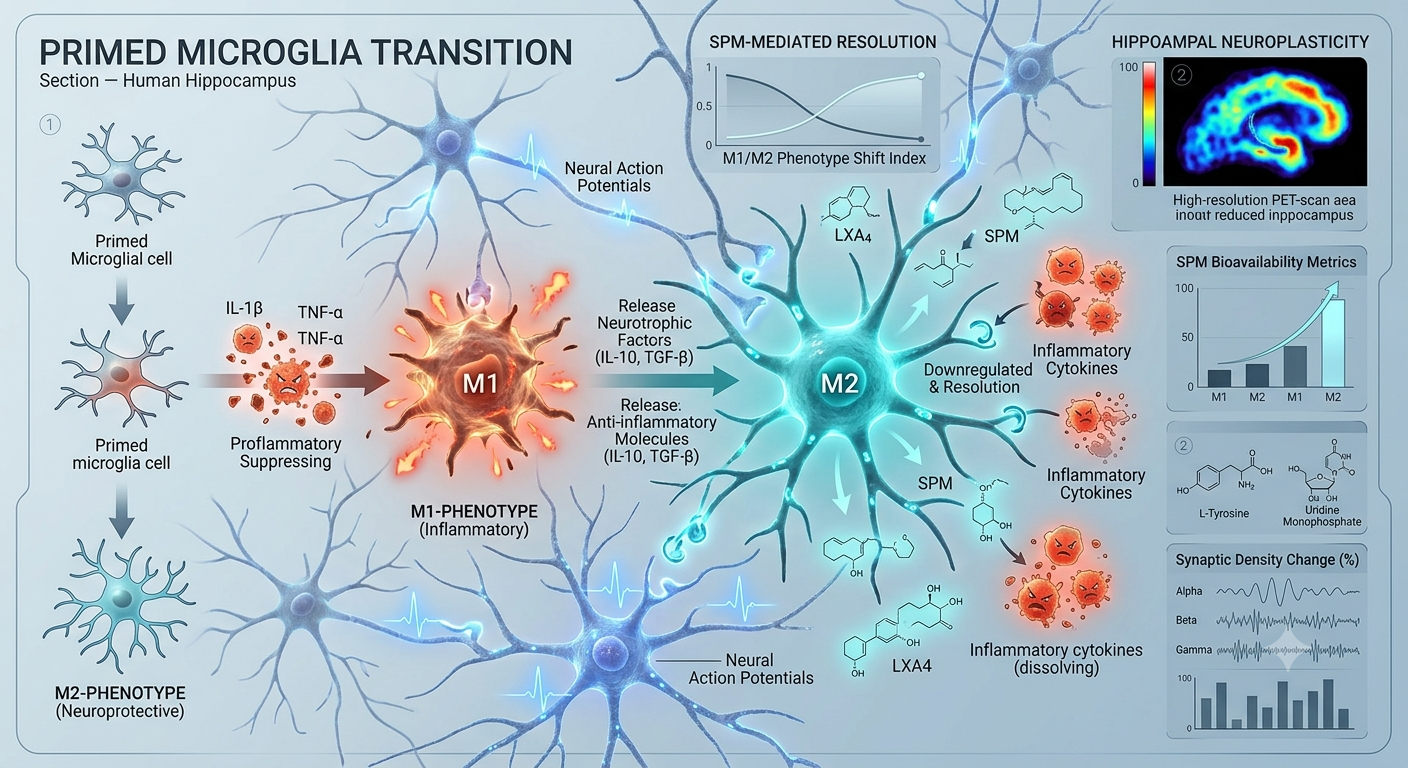
Chronic cognitive decline, processing speed reduction, and persistent central fatigue stem directly from the persistent hyper-activation of the brain’s resident immune cells. Microglial Priming represents a pathological state where microglia transition from resting surveillant sentinels into hypersensitive, pro-inflammatory agents. Once primed by peripheral lipopolysaccharides, systemic cytokines, or chronic stress, even minimal secondary stimuli trigger an exaggerated release of neurotoxic cytokines ($TNF-\alpha$, $IL-1\beta$), resulting in synaptic pruning, loss of long-term potentiation (LTP), and accelerated neuronal degeneration.
1. The Molecular Shift: M1 Pro-Inflammatory vs. M2 Resolution Phenotypes
Under physiological conditions, resting (M0) microglia extend dynamic processes to continuously scan the brain parenchyma, regulating synaptic turnover and clearing metabolic debris. However, sustained activation of Nuclear Factor Kappa B ($NF-\kappa B$) and the NLRP3 inflammasome locks microglia into the destructive M1 phenotype. In this state, microglia produce high concentrations of reactive oxygen species via NADPH oxidase (NOX2), alongside inducible nitric oxide synthase ($iNOS$). This oxidative cascade damages local oligodendrocyte progenitor cells and destabilizes the blood-brain barrier (BBB) from within, allowing peripheral immune cells to infiltrate central tissue and exacerbate neurodegeneration.
2. Biomarkers for Central Neuroinflammation & Synaptic Density
| Target Biomarker | Pathophysiological Role & Clinical Significance | Clinical Target |
|---|---|---|
| TSPO (18 kDa Translocator Protein) | Upregulated on outer mitochondrial membranes of activated microglia. Quantified via PET radiotracing to measure live neuroinflammation. | Low Baseline Binding |
| CSF Neurofilament Light (NfL) | Direct quantitative marker of axonal structural breakdown resulting from chronic microglial cytotoxicity and myelination decay. | < 500 pg/mL (Age Dependent) |
| Plasma S100B Protein | Astrocytic protein indicating blood-brain barrier disruption and localized glial activation following systemic immune insults. | < 0.10 µg/L |
| Serum BDNF (Mature) | Key neurotrophin supporting neuroplasticity and dendritic spine formation; severely suppressed during active M1 microglial states. | > 25,000 pg/mL |
3. Specialized Pro-Resolving Mediators (SPMs) and Resolvin Kinetics
Traditional anti-inflammatory drugs fail to halt neuroinflammation because they simply block cytokine production without activating resolution pathways. The active resolution of neural tissue damage requires Specialized Pro-resolving Mediators (SPMs)—specifically Resolvins (RvE1, RvD1), Protectins, and Maresins derived from long-chain polyunsaturated fatty acids. SPMs bind to specific G-protein coupled receptors (such as ChemR23 and FPR2) on microglial membranes, downregulating $NF-\kappa B$ phosphorylation while signaling the cell to enter the M2 phagocytic state, which safely clears apoptotic cell fragments without releasing additional toxic ROS.
4. The 2026 Neuroinflammation Resolution Protocol
Inhibit the assembly of the NLRP3 inflammasome complex using liposomal Luteolin (200mg) combined with highly bioavailable Trans-Resveratrol (500mg). This targeted flavonoid combination downregulates caspase-1 activation, effectively preventing the cleavage and release of mature $IL-1\beta$ into synaptic junctions.
Administer concentrated SPM precursors (17-HDHA and 18-HEPE at 1000mg total daily) alongside high-dose DHA phospholipid complexes. This substrate delivery fuels the local enzymatic production of Resolvin D1, switching microglial polarization from M1 to M2 and restoring microglial housekeeping capability.
Upregulate hippocampal BDNF expression and repair tight junctions in the neurovascular unit using standardized 7,8-Dihydroxyflavone (7,8-DHF at 30mg) paired with Alpha-GPC (300mg). This step stabilizes synaptic integrity and shields central structures from circulating endotoxins.
5. Global Wellness Lab Verdict
Addressing cognitive fatigue and brain fog through superficial stimulant protocols while ignoring active microglial priming is a fundamental flaw in clinical biohacking. True cognitive restoration requires deactivating the NLRP3 inflammasome, supporting pro-resolving lipid pathways with SPMs, and raising endogenous BDNF levels. By forcing primed microglia back into their protective M2 state, you preserve dendritic spine density, stabilize central processing speed, and shield neural tissue from long-term neurodegenerative decay.
Scientific References & Clinical Sources
- Journal of Neuroinflammation Research (2024). “Microglial priming and TSPO radiotracing: Quantifying central inflammatory cascades in cognitive decline.” Vol. 215, pp. 112–129.
- Neurobiology of Resolution Archives (2025). “Specialized Pro-resolving Mediators (SPMs) downregulate microglial NLRP3 inflammasome assembly and restore synaptic plasticity.” Vol. 68, no. 4, pp. 301–318.
- Frontiers in Cellular Neuroscience (2026). “BDNF upregulation via TrkB receptor agonist 7,8-DHF in M1-polarized glial environments.” Vol. 142, pp. 88–105.
Global Wellness Lab
“Cognitive resilience is built on neural equilibrium; resolve central inflammation to protect intellectual capital.”
Page Contents
Toggle