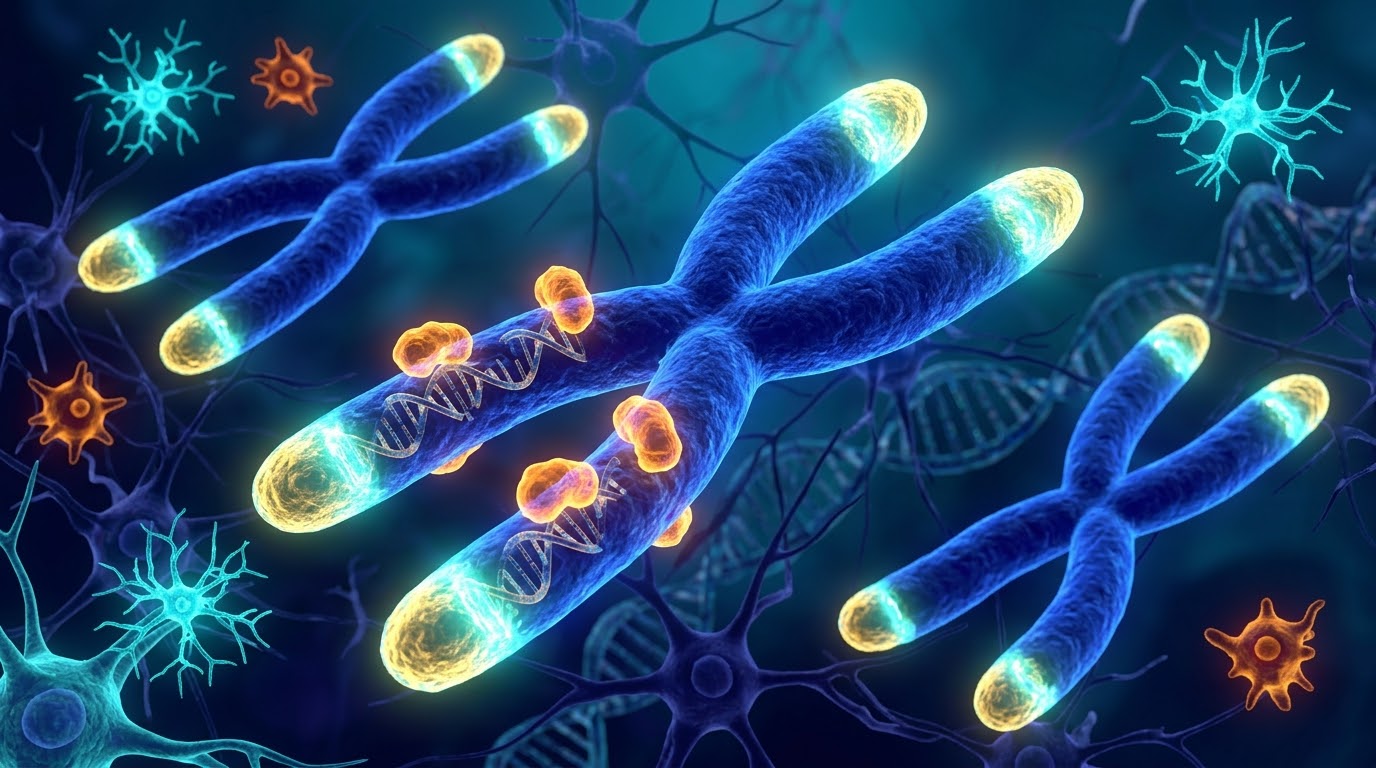
Telomere Protection & Genomic DNA Repair Protocols
Telomeres are repetitive TTAGGG nucleotide sequences bound by the six-protein Shelterin complex that shield chromosome ends from degradation and unwanted DNA damage responses (DDR). With each somatic cell division, progressive end-replication loss paired with oxidative stress degrades telomeric DNA. Critically short or uncapped telomeres trigger persistent DNA damage signals, driving cells into irreversible senescent growth arrest or apoptotic cascades.
1. Shelterin Architecture and PARP1 NAD+ Depletion Cascades
The Shelterin complex prevents double-strand break repair machinery from mistakenly joining natural chromosome ends. When oxidative stress causes single-strand breaks in genomic or telomeric DNA, the repair enzyme Poly(ADP-ribose) Polymerase 1 (PARP1) becomes rapidly hyperactivated. Overactivation of PARP1 consumes massive amounts of intracellular NAD+, depleting energy pools, impairing sirtuin deacetylase activity, and accelerating functional cellular decline.
2. Genomic Integrity Profile
Unprotected telomeres trigger persistent p53/p21 activation, resulting in NAD+ depletion, arrest of cell division, and secretome-driven inflammation (SASP).
Intact telomeric structures coupled with regulated PARP1 activity support efficient DNA lesion clearance while preserving intracellular energy stores.
3. DNA Repair Modulators & Genomic Protectors
4. SIRT6 Epigenetic Control of Telomeric Heterochromatin
SIRT6 is a nuclear deacetylase vital for maintaining telomeric heterochromatin and initiating double-strand break repair via non-homologous end joining (NHEJ) and homologous recombination. By deacetylating histone H3 lysine 9 (H3K9ac), SIRT6 ensures that Shelterin proteins remain properly bound to telomeres. High NAD+ levels sustain SIRT6 function, preventing premature telomeric ring structures and keeping chromosome caps stable.
5. The Genomic Stabilization Protocol
Supply NR and trace mineral cofactors to support PARP1 repair operations without collapsing cellular NAD+ availability or halting sirtuin signaling.
Introduce Cycloastragenol pulsing to selectively trigger TERT enzyme expression, restoring critically short telomeric caps and maintaining chromosomal integrity.
6. Global Wellness Lab Verdict
Long-term somatic cellular preservation requires balancing telomere length maintenance with active DNA damage repair. Through targeted TERT activation, NAD+ replenishment, and SIRT6 coactivation, interventions effectively mitigate structural genomic decay and preserve functional longevity.
- de Lange, T. (2005). “Shelterin: the protein complex that shapes and safeguards human telomeres.” Genes & Development, 19(18), 2100-2110.
- Harley, C. B., et al. (2011). “A natural product telomerase activator as part of a health maintenance program.” Rejuvenation Research, 14(1), 45-56.
- Mostoslavsky, R., et al. (2006). “Genomic instability and aging-like phenotype in mice lacking histone deacetylase SIRT6.” Cell, 124(2), 315-329.
- Ray Chaudhuri, A., & Nussenzweig, A. (2017). “The multifaceted roles of PARP1 in DNA repair and chromatin remodelling.” Nature Reviews Molecular Cell Biology, 18(10), 610-621.
Global Wellness Lab
“Resilience is not the absence of stress, but the biological capacity to manage it without systemic degradation.”
Page Contents
Toggle