Telomeric Protection Dynamics & TERT Enzymatic Reactivation Protocols
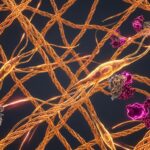
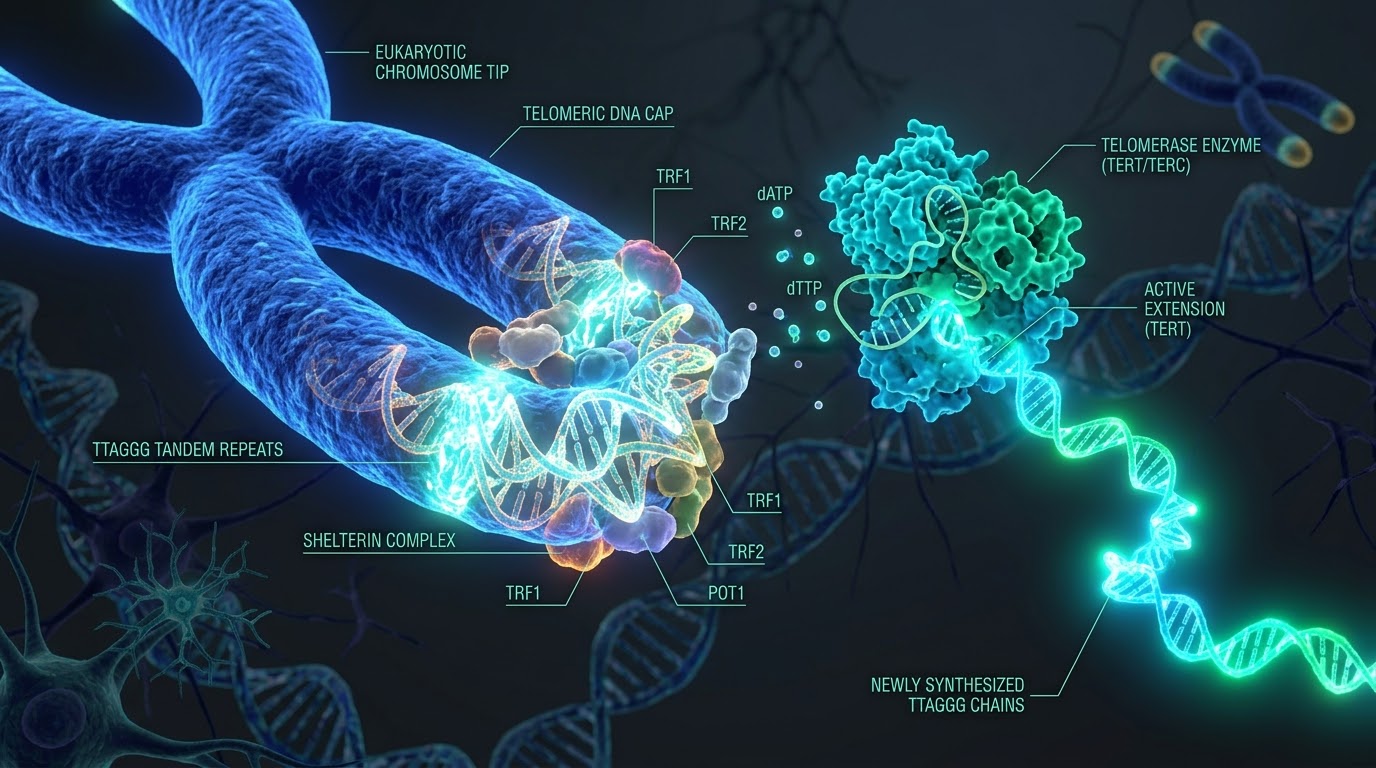
Telomeres are repetitive TTAGGG nucleotide sequences located at eukaryotic chromosome termini that safeguard genomic stability. With each round of DNA replication, the end-replication problem leads to progressive telomere attrition. Critical telomeric shortening triggers persistent DNA Damage Response (DDR) signaling, p53/p21 pathway activation, and permanent replicative senescence. Re-establishing telomerase activity while reinforcing Shelterin complex integrity is vital for genomic preservation.
1. Telomerase Reverse Transcriptase (TERT) & TERC Assembly
Telomerase is a ribonucleoprotein complex composed of a catalytic subunit, Telomerase Reverse Transcriptase (TERT), and an RNA template molecule (TERC). TERT synthesizes telomeric DNA de novo onto chromosome ends. Transient hTERT promoter activation via specific small-molecule modulators elongates short telomeres without inducing malignant transformation, stabilizing single-stranded 3′ overhangs and preventing ATM/ATR kinase activation.
[ MOLECULAR DYNAMICS // THE SHELTERIN PROTEIN SHIELD ]
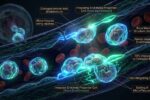
The Shelterin complex consists of six specialized proteins (TRF1, TRF2, TIN2, POT1, TPP1, RAP1) that fold telomeric DNA into t-loops, hiding chromosome ends from being recognized as double-strand breaks (DSBs):
- TRF1 & TRF2: Bind double-stranded TTAGGG repeats and induce topological T-loop folding.
- POT1: Binds single-stranded G-overhangs, directly blocking ATR kinase activation.
- TPP1 & TIN2: Bridge the complex and recruit TERT to terminal overhangs during S-phase.
2. Chromosomal Terminal Integrity Profile
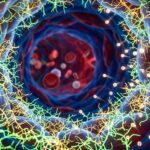
Exposed single-stranded DNA triggers 53BP1 foci assembly, activating CHK1/CHK2 signaling pathways, halting cell cycle progression, and driving irreversible senescence.
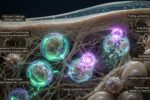
Optimal TRF2/POT1 binding seals chromosome tips into functional t-loops, shielding DNA from repair enzymes and extending cellular replicative lifespan.
3. Telomerase Activators & Genomic Modulators
4. Mitigating Oxidative Single-Strand Breaks in Telomeres
G-rich telomeric sequences (5′-TTAGGG-3′) are vulnerable to oxidative cleavage by 8-hydroxy-2′-deoxyguanosine (8-OHdG) lesions. Because base excision repair (BER) is less efficient at chromosome ends, unresolved oxidative lesions accelerate telomere loss independently of cell division. Systemic administration of lipid-soluble antioxidants and PARP-1 cofactors reduces oxidative cleavage, preserving telomere length.
5. The Genomic Telomere Maintenance Protocol
Administer Cycloastragenol in cyclical 12-week phases to activate hTERT transcription, driving new TTAGGG sequence synthesis on short telomeric ends.
Combine Astragaloside IV with NAD+ precursors and Zinc cofactors to maintain TRF2/POT1 binding, folding chromosome ends into protected t-loop configurations.
6. Global Wellness Lab Verdict
Preserving telomeric length and Shelterin cap integrity is essential to prevent cellular senescence. Combining targeted TERT activators with oxidative protection shields chromosomal ends, maintaining tissue renewal capacity and long-term genomic stability.
- Blackburn, E. H. (2005). “Telomeres and telomerase: their mechanisms of action and the effects of altering their functions.” FEBS Letters, 579(4), 859-862.
- de Lange, T. (2005). “Shelterin: the protein complex that shapes and safeguards human telomeres.” Genes & Development, 19(18), 2100-2110.
- Harley, C. B., et al. (2010). “A natural product telomerase activator as part of a health maintenance program.” Rejuvenation Research, 13(5), 641-647.
- Blasco, M. A. (2007). “Telomere length, stem cells and aging.” Nature Chemical Biology, 3(10), 640-649.
Global Wellness Lab
“Resilience is not the absence of stress, but the biological capacity to manage it without systemic degradation.”
Page Contents
Toggle