Category: Consumer Guide & Lab Reports
Technical Level: Essential
Read Time: 10 minutes
1. Beyond the Marketing: The “Supplement Facts” Reality
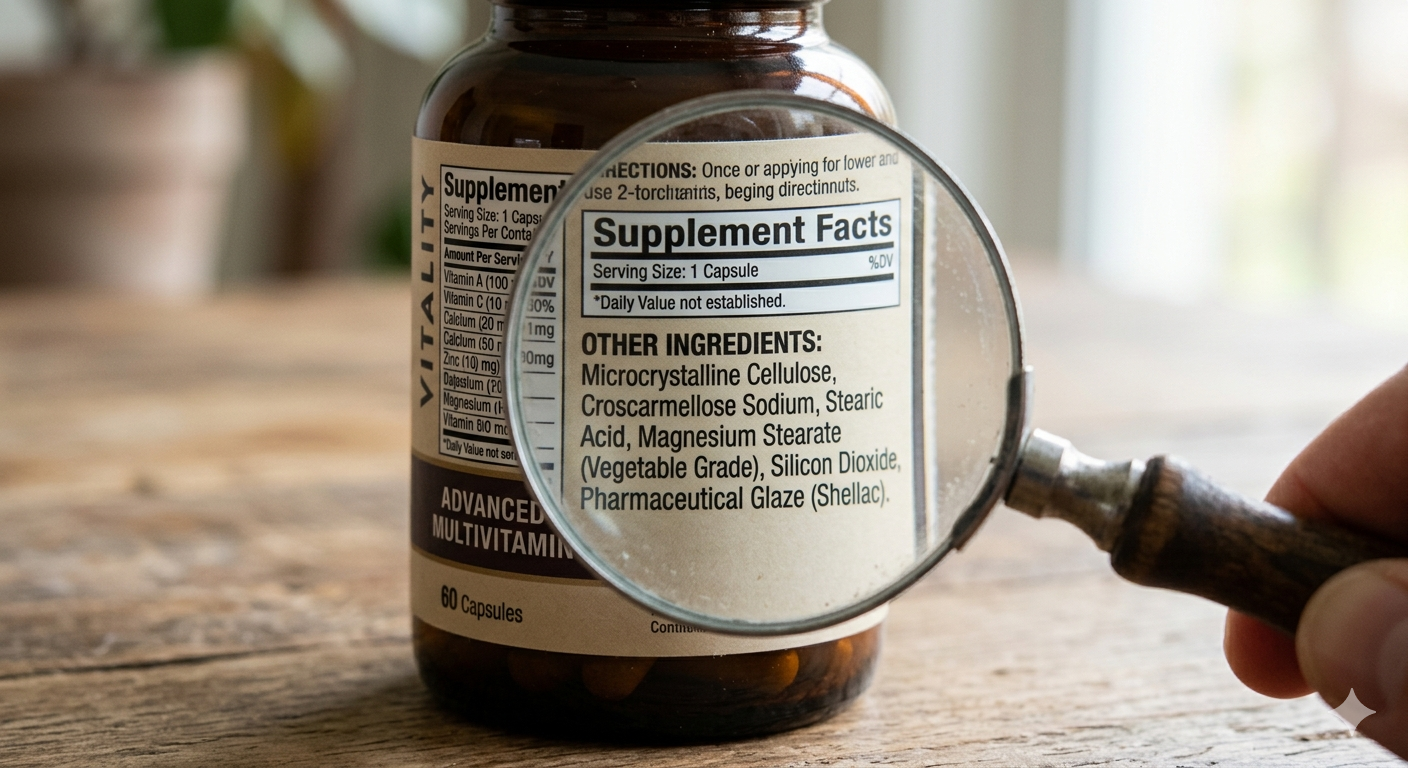
When you pick up a supplement bottle, the front label is designed by marketers to grab your attention with bold claims like “Clinical Strength” or “Maximum Absorption.” However, the only part of the bottle that carries legal weight is the Supplement Facts panel.
In 2026, the savvy consumer knows that a brand’s transparency is directly proportional to its quality. If a brand hides behind vague terminology, there is usually a financial reason for it.
2. The “Proprietary Blend” Trap: Transparency vs. Mystery
A Proprietary Blend is a collection of ingredients where only the total weight of the blend is disclosed, not the individual dosage of each component.
- The Excuse: Brands claim they use these blends to protect their “secret formula” from competitors.
- The Reality: In most cases, these blends allow companies to “label dress.” This means they include a tiny, ineffective amount of an expensive ingredient (like Saffron or CoQ10) and fill the rest of the blend with cheap ingredients (like Magnesium Stearate or Rice Flour).
Lab Rule: If a label says “Focus Blend (500mg)” and lists 10 ingredients, you have no way of knowing if the key ingredient is present at 490mg or 1mg. Always prioritize brands that list exact dosages (mg) for every ingredient.
3. Decoding “Other Ingredients”: The Hidden Fillers
Below the supplement facts, you will find a section called “Other Ingredients.” These are the excipients used for manufacturing, shelf stability, or aesthetics. While some are harmless, others can interfere with the “Bioavailability Manifesto” we discussed.
The Good, The Bad, and The Toxic:
| Ingredient | Purpose | Verdict | Why? |
|---|---|---|---|
| Rice Flour | Filler | Safe | Hypoallergenic and inert. |
| Magnesium Stearate | Flow Agent | Neutral | Helps machinery run; fine in small doses. |
| Titanium Dioxide | Whitener | AVOID | Banned in Europe; linked to gut inflammation. |
| Artificial Colors | Aesthetics | AVOID | Red 40 or Blue 1 provide zero health benefit. |
| Silicon Dioxide | Anti-caking | Safe | Natural mineral that prevents clumping. |
4. Understanding “Standardization” (The % Rule)
When looking at herbal extracts (like Ashwagandha or Turmeric), simply seeing “500mg” isn’t enough. You need to look for the Standardization.
- Weak Label: “Ashwagandha Root – 500mg” (Could be just ground-up root with zero active compounds).
- Strong Label: “Ashwagandha Extract – 500mg (Standardized to 5% Withanolides).”
Why it matters: Standardization guarantees that you are getting the bioactive molecule that actually creates the health effect. Without it, you are essentially buying expensive “plant dust.”
5. Checklist: The 2026 Global Wellness Lab Audit
Before you click “buy” on your next supplement, run the product through this 5-point checklist:
- Zero Proprietary Blends: Does it list the exact milligrams for every active ingredient?
- Standardized Extracts: Are the herbs standardized to a specific percentage of active compounds?
- Clean “Other Ingredients”: Is the list free from artificial dyes, titanium dioxide, and hydrogenated oils?
- Third-Party Seals: Does it have an NSF, USP, or Informed-Sport logo?
- Manufacturer Transparency: Does the website provide a Certificate of Analysis (CoA) for the current batch?
6. Verdict: Transparency is the Ultimate Ingredient
At Global Wellness Lab, our lab reports prioritize products that treat the consumer like a partner, not a target. A clean label with transparent dosages is the first indicator of a product that actually works.
Don’t let a “Proprietary Blend” hide a mediocre formula. Demand data, read the “Other Ingredients,” and supplement with confidence.