Adrenal Resilience Protocol
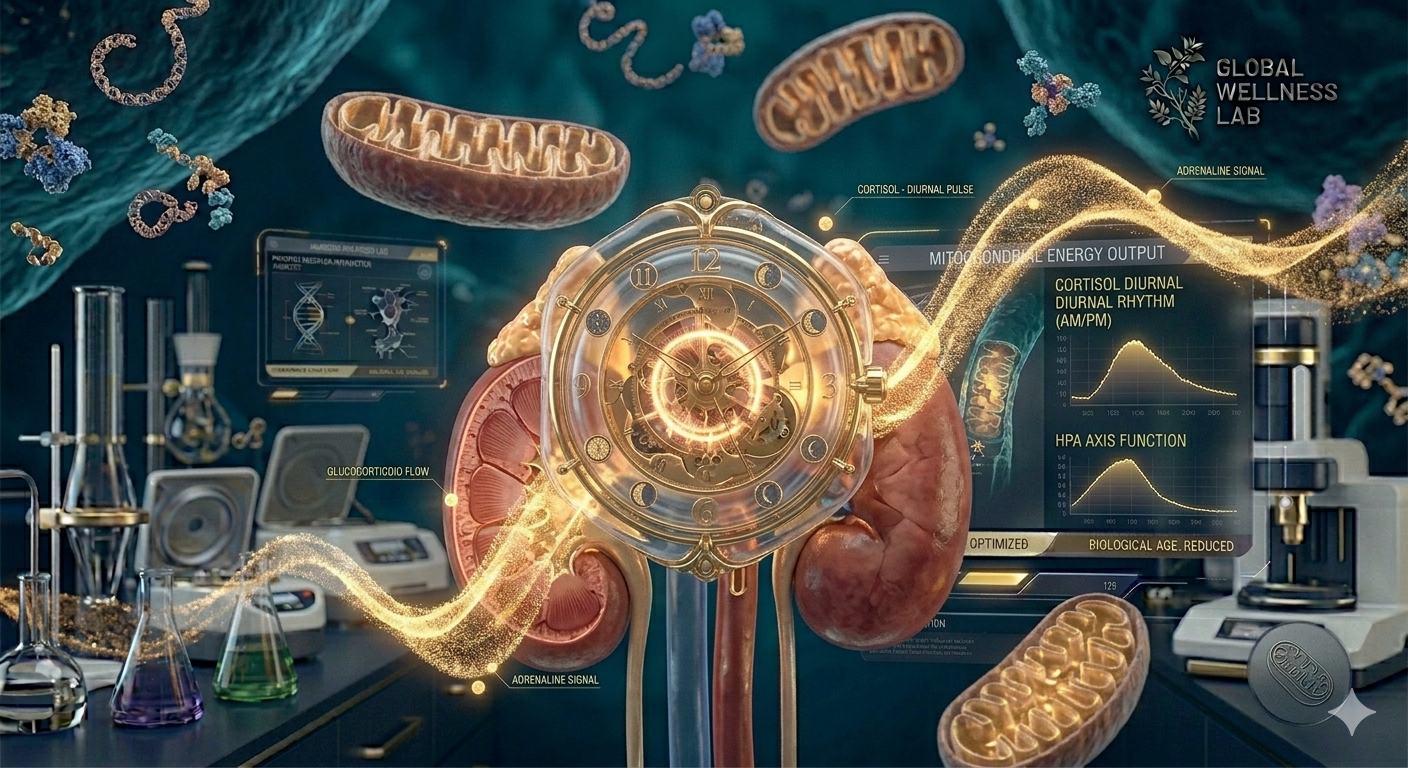
The **HPA Axis** (Hypothalamic-Pituitary-Adrenal) serves as the body’s central stress response system. At **Global Wellness Lab**, we analyze cortisol not as an “enemy,” but as a essential circadian signaling molecule that requires precise calibration.
1. The Cortisol Awakening Response (CAR)
A healthy HPA axis is characterized by a robust CAR—a sharp 50-75% increase in cortisol within 30 minutes of waking. This surge is critical for metabolic activation and mental alertness. Blunted CAR is often the first biochemical marker of chronic exhaustion.
2. HPA Axis Dysfunction vs. Fatigue
Modern science has moved beyond the term “Adrenal Fatigue.” The condition is more accurately described as **HPA Axis Dysfunction**, where the brain’s signaling to the adrenals becomes desensitized due to prolonged glucocorticoid exposure, leading to circadian misalignment.
Lab Note: The Pregnenolone Steal
Under chronic stress, the body prioritizes cortisol production over anabolic hormones like DHEA and Testosterone. This “metabolic shunt” is a survival mechanism that sacrifices long-term repair for short-term survival.
3. Adaptogenic Modulation
Adaptogens like **Ashwagandha (KSM-66)** and **Rhodiola Rosea** function as rheostats for the stress response. They don’t simply lower cortisol; they modulate the feedback loops, helping the system return to homeostasis more efficiently after a stressor.
4. The Phosphatidylserine Interface
Phosphatidylserine (PS) is a phospholipid that has shown the ability to blunt excessive ACTH and cortisol spikes during high-intensity physical or mental stress, protecting muscle tissue and cognitive function from catabolic damage.
5. Circadian Light Hygiene
Cortisol and Melatonin exist in an inverse relationship. Exposure to high-intensity blue light at night triggers a cortisol spike that inhibits melatonin synthesis. Our protocol mandates 450nm light blocking after sunset to preserve the nocturnal hormonal window.
6. Micronutrient Cofactors
The adrenal cortex has the highest concentration of **Vitamin C** in the human body. During stress, these stores are rapidly depleted. Supplementing with buffered Vitamin C and Magnesium is essential to support the enzymatic steps of steroidogenesis.
Global Wellness Lab
“Resilience is not the absence of stress, but the biological capacity to manage it without systemic degradation.”
This is a technical educational analysis and does not substitute professional medical advice.