GHK-Cu & Immune Defense
At Global Wellness Lab, we monitor the frontier of regenerative medicine. The GHK-Cu peptide (Glycyl-L-Histidyl-L-Lysine) is emerging as a master regulator of immune surveillance and tissue remodeling.
1. The Molecular Messenger
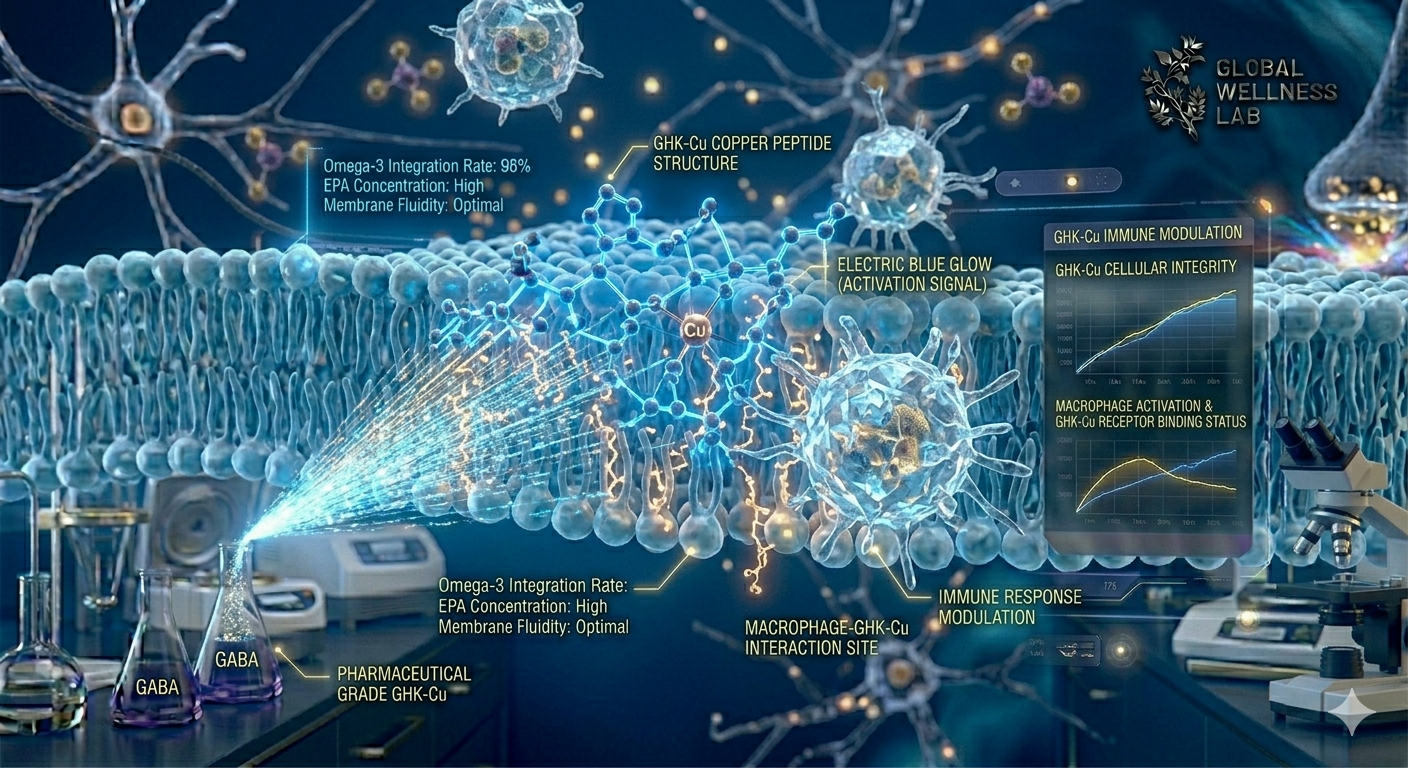
GHK-Cu is a naturally occurring copper complex that decreases with age. It acts as a signaling molecule that modulates the expression of over 4,000 human genes, recalibrating the immune system to a more “youthful” state of responsiveness.
2. Macrophage Polarization
One of the most critical roles of GHK-Cu is its ability to shift macrophages from a pro-inflammatory (M1) to an anti-inflammatory and regenerative (M2) phenotype, accelerating the resolution of immune challenges.
3. Tissue Repair & Cytokine Balance
The peptide promotes the synthesis of collagen and elastin while simultaneously regulating the secretion of pro-inflammatory cytokines like IL-6 and TNF-alpha, preventing the “cytokine storms” associated with hyper-inflammation.
4. DNA Repair & Stem Cell Activation
Recent studies indicate that GHK-Cu enhances the repair of damaged DNA in cells exposed to radiation or toxins. It also supports the proliferation of adult stem cells, ensuring a steady supply of new cells for the immune barrier.
5. Antioxidant Enzyme Upregulation
GHK-Cu increases the levels of Superoxide Dismutase (SOD) and Glutathione. These endogenous antioxidants are the first line of defense against oxidative stress during an active immune response.
6. Bioavailability & Delivery Systems
Because peptides are easily degraded, the Global Wellness Lab emphasizes the use of liposomal delivery or injectable grade purity to ensure that the GHK-Cu molecule reaches its cellular targets without enzymatic interference.
Global Wellness Lab
“Regenerative immunity is the next frontier. GHK-Cu is the key that unlocks the body’s latent healing potential.”
This is a technical educational analysis and does not substitute professional medical advice.