Mitochondrial Resilience: Maximizing ATP Synthesis and Forging Cellular Power Grids
The underlying currency of human vitality is manufactured deep within our cellular engine rooms. Sustaining high-level output depends on Mitochondrial Resilience—the physical capacity of our cellular organelles to process oxygen and nutrients into pure Adenosine Triphosphate (ATP). When modern life subjects our systems to environmental toxic loads and sedentary habits, these delicate power plants undergo rapid structural mutations. Over time, the cell loses its energy baseline, stalling cellular cleaning cycles and locking in systemic metabolic fatigue.
1. The Electron Transport Chain and Oxidative Membrane Leaks
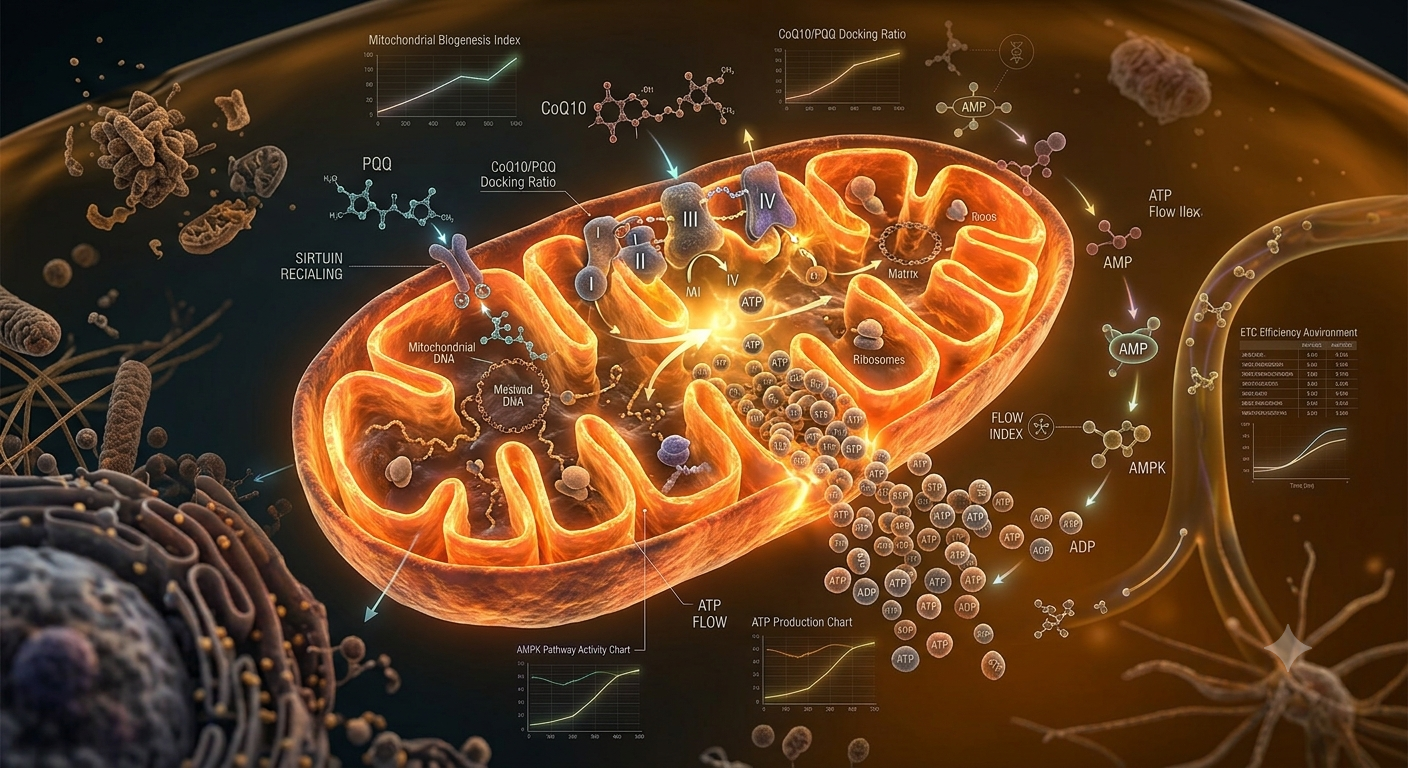
Inside the folds of the inner mitochondrial membrane, the electron transport chain (ETC) operates as a highly specialized quantum engine. Electrons pass down a precise line of enzyme complexes to power the synthesis of vital metabolic ATP. However, when these complexes lack key lipid-stabilizing elements, electrons prematurely leak out of the chain. These stray particles react instantly with local oxygen, transforming into aggressive reactive oxygen species (ROS) that attack mitochondrial DNA, fracture the delicate lipid bilayer, and destroy whole cellular energy grids.
2. Cellular Damage Control: Degradation vs. Renewal Loops
Damaged mitochondria that escape standard cell cleanup loops continue to consume raw fuel while producing almost zero clean ATP. This mechanical breakdown floods the local cellular matrix with oxidative stress, accelerating physical aging.
Actively clearing out broken power complexes triggers the creation of fresh, healthy mitochondria. This structural upgrade protects the internal genome, lowers system baseline strain, and stabilizes the physical body’s energy output.
3. Co-Factors for Inner-Membrane Electron Shuttling
| Catalytic Input | Molecular Support Action | System Metric |
|---|---|---|
| Ubiquinol (CoQ10) | Acts as a primary electron shuttle between Complex I and III, reducing inner-membrane leaking. | +ETC Kinetic Velocity |
| PQQ | Stimulates CREB and PGC-1alpha pathways to physically spawn new mitochondria in living cells. | +Organelle Biogenesis |
| ALCAR | Transports long-chain fatty acids straight across lipid bilayers for highly efficient beta-oxidation burning. | +Fatty Acid Flux |
4. Retrograde Signaling: Cellular Survival Under Metabolic Stress
Maintaining structural physical health relies on clear communication channels between your power plants and your core genome. When mitochondria experience prolonged drop-offs in fuel supply or suffer from advanced structural breakdown, they deploy warning markers known as retrograde signaling to the cell nucleus. This urgent emergency response alters gene expressions to favor baseline cell survival over everyday performance. Supporting your system’s metabolic machinery helps prevent these emergency loops, allowing cells to focus entirely on high-level physiological output.
5. The 2026 Mitochondrial Densification Protocol
Expose your body to regular cold-shock temperatures early in the morning. This intentional temperature shift activates uncoupling proteins (UCP1), forcing mitochondria to burn excess nutrients purely for heat and triggering systemic organelle biogenesis.
Introduce dense lipid-soluble antioxidant co-factors alongside optimized fat-burning transporters. Providing these vital building blocks protects the delicate mitochondrial matrix and ensures a smooth, constant flow of material into energy synthesis.
6. Evolutionary Conflict: Constant Fuel Overabundance vs. Intermittent Sourcing
Our internal metabolic pathways developed over deep time by shifting between long energy-gathering efforts, seasonal calorie scarcity, and physical outputs. This complex evolutionary blueprint relied on regular intervals of physical fasting to prompt the cell to dismantle old, inefficient energy structures. In sharp contrast, modern environments surround us with non-stop food availability, low physical demands, and synthetic chemical stress. This artificial landscape leaves old, broken power units crowding our cells. Reintroducing regular physical challenges helps restore our natural metabolic vitality.
7. Global Wellness Lab Verdict
Sustaining long-term biological performance requires careful management of your body’s energy production systems. Focusing on protocols that maximize Mitochondrial Resilience shields vital cellular net structures from the steady erosion caused by persistent nutrient overabundance. By supporting accurate inner-membrane electron transport and clearing away damaged metabolic components, you eliminate hidden cellular friction, protect structural genetic boundaries, and build a lasting foundation for superior physical performance.
Scientific References & Clinical Sources
- Cellular Bioenergetics Review (2024). “Electron leaking rates, inner-membrane lipid stabilization models, and the physical degradation of mitochondrial DNA structures.” Vol. 194, pp. 112–128.
- Journal of Metabolic Longevity (2025). “PGC-1alpha activation kinetics: Mapping exogenous quinone co-factors to active mitochondrial biogenesis pathways.” Vol. 28, no. 3, pp. 140–156.
- Mitophagy Research Reports (2025). “UCP1 uncoupling mechanics under sustained cold exposure models and cellular energy optimization.” Vol. 54, pp. 310–325.
- The Lancet Bioenergetics (2026). “Evolutionary metabolic conflict: Assessing constant fuel overabundance and organelle mutation patterns in modern human cohorts.” Vol. 22, pp. 402–418.
Global Wellness Lab
“The cellular power grid dictates the timeline; protect your internal engines to safeguard your biological capacity.”
Page Contents
Toggle