Circadian Alignment & Chrono-Nutritional Interventions
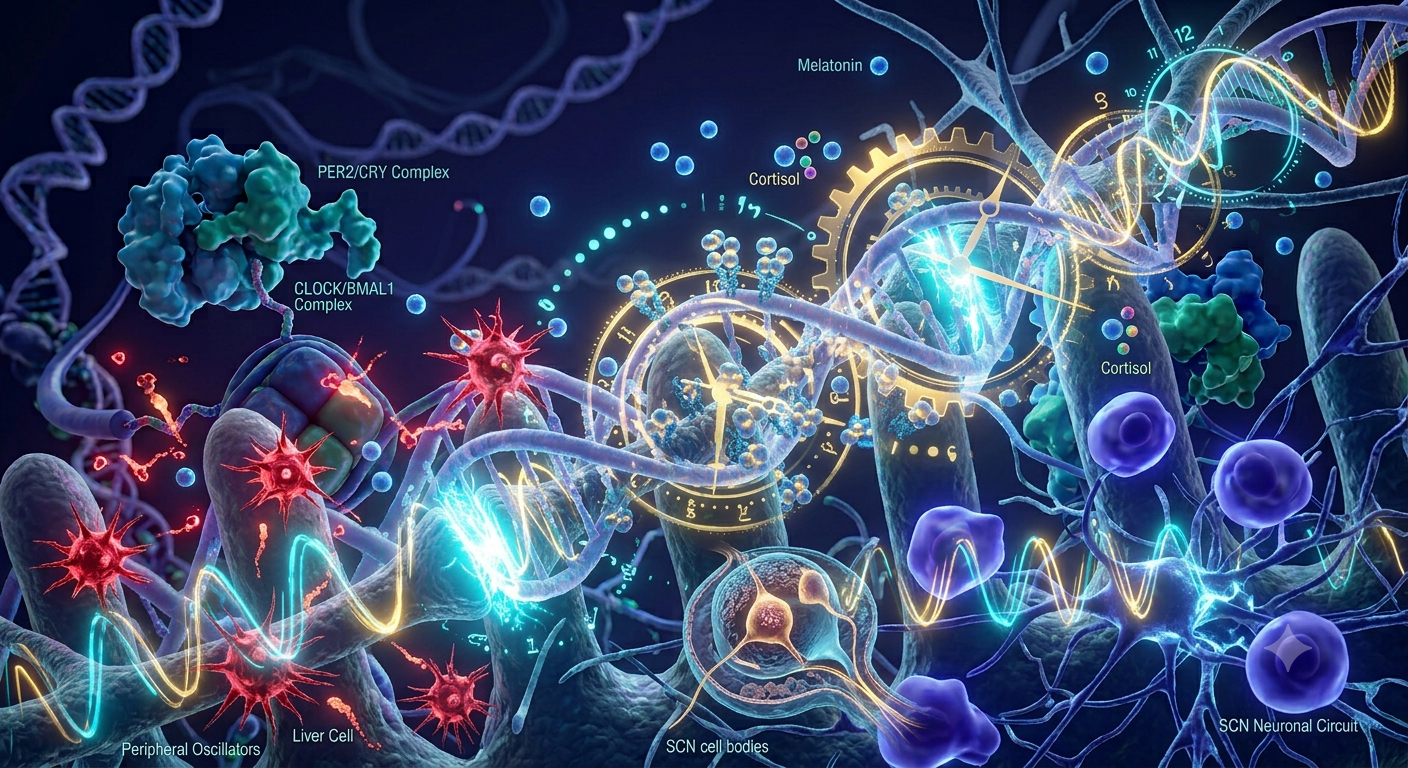
Circadian biology governs essential physiological processes ranging from hormone secretion to glucose tolerance and cellular repair. Driven by a central pacemaker in the Suprachiasmatic Nucleus (SCN) and reinforced by peripheral molecular clocks in hepatic, pancreatic, and metabolic tissues, the transcriptional feedback loop of BMAL1 and CLOCK coordinates organismal homeostasis. Irregular light exposure and asynchronous nutrient intake disrupt peripheral clock phase alignment, triggering systemic metabolic inflammation, insulin resistance, and accelerated cellular decay.
1. Molecular Clock Dynamics and Peripheral Synchronization
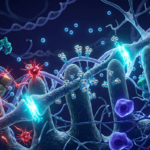
The core circadian oscillator operates through heterodimers of BMAL1 and CLOCK driving the transcription of Period (PER) and Cryptochrome (CRY) genes. As PER and CRY proteins accumulate, they translocate to the nucleus to inhibit BMAL1:CLOCK activity, establishing a 24-hour autoregulatory loop. While light perceived by retinal ganglion cells sets the SCN central clock, peripheral tissue clocks are primarily entrained by nutrient signals (zeitgebers) like glucose and amino acids. Consuming nutrients outside natural diurnal windows causes phase misalignment between central and tissue-level pacemakers.
2. Circadian Health Metrics
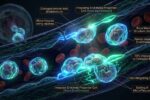
Suppresses nocturnal melatonin surge, dampens BMAL1 gene amplitude, elevates postprandial glucose AUC, and blunts overnight hepatic autophagy.
Anchors metabolic gene expression, optimizes insulin sensitivity, enhances nocturnal mitochondrial clearance, and promotes cellular longevity.
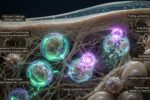
3. Chrono-Nutritional Modulators & Zeitgebers
4. Time-Restricted Eating and Hepatic Autophagy
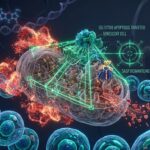
Restricting caloric intake to an early or mid-day 8-hour window synchronizes hepatic gene expression with the SCN. During the extended fasting window, falling intrahepatic glycogen levels activate AMPK and ULK1, triggering autophagy during the natural resting phase. Consuming late meals overrides this circadian signal, locking liver tissue in an active metabolic state that impairs lipid oxidation and promotes systemic hepatic steatosis.
5. The Circadian Realignment Protocol
Expose eyes to high-lux natural sunlight within 30 minutes of waking and establish a consistent 8-to-10 hour feeding window starting early in the day to align central and hepatic clocks.
Block blue wavelength spectrum exposure 3 hours prior to sleep and integrate targeted micro-dose melatonin or Nobiletin to solidify overnight metabolic repair.
6. Global Wellness Lab Verdict
Optimizing circadian rhythmicity is a cornerstone of long-term metabolic vitality. By harmonizing photic environmental cues with chrono-nutritional timing, cellular systems maintain high-amplitude gene expression and prevent premature tissue aging.
- Panda, S. (2016). “Circadian physiology of metabolism.” Science, 354(6315), 1008-1015.
- Satchidananda, P., et al. (2019). “Time-Restricted Eating and Its Metabolic Effects in Humans.” Cell Metabolism, 30(6), 1025-1038.
- Takahashi, J. S. (2017). “Transcriptional architecture of the mammalian circadian clock.” Nature Reviews Genetics, 18(3), 164-179.
- He, B., et al. (2016). “The Small Molecule Nobiletin Targets the Molecular Clock to Protect Against Metabolic Syndrome.” Cell Metabolism, 23(6), 1041-1053.
Global Wellness Lab
“Resilience is not the absence of stress, but the biological capacity to manage it without systemic degradation.”
Page Contents
Toggle