Senolytics & SASP Clearance: Selective Elimination of Senescent Cells
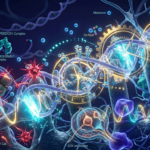
Cellular senescence—a permanent state of cell-cycle arrest triggered by unrepairable DNA damage, telomere attrition, or oncogenic stress—serves as a primary driver of organismal aging. Although senescence initially prevents malignant transformation, the persistent accumulation of p16INK4a and p21CIP1 positive senescent cells leads to the chronic secretion of the Senescence-Associated Secretory Phenotype (SASP). SASP contains pro-inflammatory cytokines (IL-6, IL-1β), matrix metalloproteinases (MMPs), and growth factors that disrupt neighboring tissue architecture and spread paracrine senescence.
1. SCAP Networks and Senolytic Targeting Mechanisms
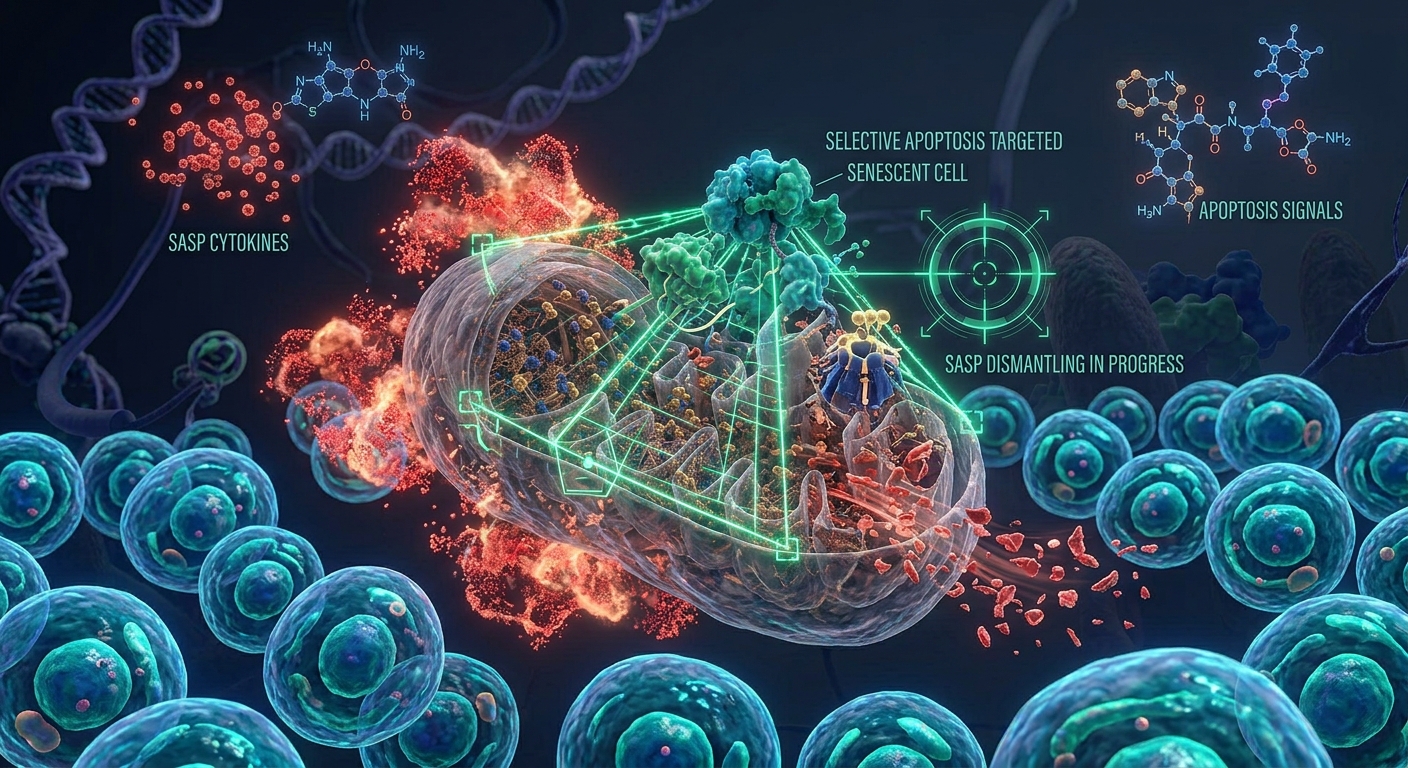
Senescent cells resist their own pro-apoptotic microenvironment by upregulating Senescent Cell Anti-Apoptotic Pathways (SCAPs). These survival networks depend on BCL-2/BCL-XL family proteins, PI3K/AKT signaling, p53/p21, and specific heat-shock proteins. Senolytic compounds transiently disable these SCAP networks, allowing pro-apoptotic signals to selectively trigger apoptosis in senescent cells while leaving healthy, non-senescent cells completely unharmed.
2. Cellular Senescence Profile
High p16INK4a burden drives extracellular matrix degradation via MMPs and fuels systemic inflammaging, accelerating tissue dysfunction.
Pulsed clearance of senescent cells removes SASP signaling, liberating resident stem cell niches for tissue regeneration.
3. Targeted Senolytic Bioactives & Molecules
4. Senomorphic Interventions vs. Direct Senolysis
While senolytic agents directly eliminate senescent cells by triggering apoptosis, senomorphic agents attenuate SASP production without killing the cell. Inhibiting key SASP master regulators—such as NF-kB, mTOR, and p38 MAPK—dampens the toxic paracrine signals released into systemic circulation. Combining intermittent senolytic pulses with continuous senomorphic suppressors provides a comprehensive dual-action approach to controlling tissue degradation.
5. The Pulsed Clearance Protocol
Execute a “hit-and-run” dosing protocol using bioavailable Fisetin for 2 consecutive days per month to temporarily disable SCAPs and purge accumulated senescent cells.
Incorporate continuous low-dose Quercetin phytosome and NF-kB inhibitors to prevent SASP-mediated tissue degradation between senolytic clearing pulses.
6. Global Wellness Lab Verdict
Targeting senescent cell survival mechanisms offers a profound paradigm shift in longevity science. Through pulsed senolytic protocols, accumulated cellular waste and chronic inflammatory SASP signaling can be reduced, preserving systemic tissue function and stem cell regenerative capacity.
- Kirkland, J. L., & Tchkonia, T. (2020). “Senolytic drugs: from discovery to translation.” Journal of Internal Medicine, 288(5), 518-536.
- Yousefzadeh, M. J., et al. (2018). “Fisetin is a senotherapeutic that extends health and lifespan.” EBioMedicine, 36, 18-28.
- Xu, M., et al. (2018). “Senolytics improve physical function and increase lifespan in old age.” Nature Medicine, 24(8), 1246-1256.
- Coppé, J. P., et al. (2010). “The senescence-associated secretory phenotype: the dark side of tumor suppression.” Annual Review of Pathology, 5, 99-118.
Global Wellness Lab
“Resilience is not the absence of stress, but the biological capacity to manage it without systemic degradation.”
Page Contents
Toggle